Saturday, March 1, 2014

Unbroken

Unbroken: A World War II St...

Review of Unbroken by Laura Hillenbrand


Overview from www.goodreads.com: On a May afternoon in 1943, an Army Air Forces bomber crashed into the Pacific Ocean and disappeared, leaving only a spray of debris and a slick of oil, gasoline, and blood. Then, on the ocean surface, a face appeared. It was that of a young lieutenant, the plane’s bombardier, who was struggling to a life raft and pulling himself aboard. So began one of the most extraordinary odysseys of the Second World War.


The lieutenant’s name was Louis Zamperini. In boyhood, he’d been a cunning and incorrigible delinquent, breaking into houses, brawling, and fleeing his home to ride the rails. As a teenager, he had channeled his defiance into running, discovering a prodigious talent that had carried him to the Berlin Olympics and within sight of the four-minute mile. But when war had come, the athlete had become an airman, embarking on a journey that led to his doomed flight, a tiny raft, and a drift into the unknown.

Ahead of Zamperini lay thousands of miles of open ocean, leaping sharks, a foundering raft, thirst and starvation, enemy aircraft, and, beyond, a trial even greater. Driven to the limits of endurance, Zamperini would answer desperation with ingenuity; suffering with hope, resolve, and humor; brutality with rebellion. His fate, whether triumph or tragedy, would be suspended on the fraying wire of his will.

In her long-awaited new book, Laura Hillenbrand writes with the same rich and vivid narrative voice she displayed in Seabiscuit. Telling an unforgettable story of a man’s journey into extremity, Unbroken is a testament to the resilience of the human mind, body, and spirit.


My Review:


Much like Louis (or Louie) Zamperini, the world around him was always on the move. As a young child of Italian immigrants, Louie was always in trouble. He liked to steal things and cause a general havoc wherever he went. He seemed destined for a mental hospital or worse but then his brother Pete had a great idea. Louie would become a runner. Pete trained him until he became one the best there were and for a while it seemed as though his troubles might be over but they were only just beginning.


Unbroken tells us the story of the first part, which I just summarized as well as what happened next. We have all heard the troubled kid makes good story before and usually when that kid turns himself around, the story ends.
But of course life goes on and so must Louie. He continues running at school, winning meet after meet. Then just when all seems lost he gets himself a spot on the 1936 Olympics, the same one where Jesse Owens won four gold medals.


After that one moment in the sun, war breaks out and Louie’s dreams are cut short when he goes off to the Pacific to fight. To say that he endured terrible things there would be a gross understatement. He survived a plane crash, being lost at sea on a raft for forty-seven days, and then the terrible horrors of a Japanese prison camp.
The same courage and stubbornness that got him in trouble with the law when he was young, that kept him going when he was floating out on a raft in the Pacific, gave him the courage to survive and defy the brutality of his Japanese soldiers. He just wouldn’t let go, give in or give up.


His incredible true story kept me on the edge of my seat. It also kept me wondering: How much more can this guy take?  When my father and I were discussing this book he told me that he too was thinking, “enough already.” What more can he go through?


This book has been made into a movie directed by Angelina Jolie though I have no idea when it will be released. I only hope that she does it justice. In the meantime, I recommend this book wholeheartedly. I guarantee it will make your problems seem small in comparison and encourage you to go forward. It did for me anyway.

Saturday, February 22, 2014

Orphan Train

Orphan Train
Review of Orphan Train by Christina Baker Kline


Overview from www.bn.com: Between 1854 and 1929, so-called orphan trains ran regularly from the cities of the East Coast to the farmlands of the Midwest, carrying thousands of abandoned children whose fates would be determined by pure luck. Would they be adopted by a kind and loving family, or would they face a childhood and adolescence of hard labor and servitude?


As a young Irish immigrant, Vivian Daly was one such child, sent by rail from New York City to an uncertain future a world away. Returning east later in life, Vivian leads a quiet, peaceful existence on the coast of Maine, the memories of her upbringing rendered a hazy blur. But in her attic, hidden in trunks, are vestiges of a turbulent past.


Seventeen-year-old Molly Ayer knows that a community-service position helping an elderly widow clean out her attic is the only thing keeping her out of juvenile hall. But as Molly helps Vivian sort through her keepsakes and possessions, she discovers that she and Vivian aren't as different as they appear. A Penobscot Indian who has spent her youth in and out of foster homes, Molly is also an outsider being raised by strangers, and she, too, has unanswered questions about the past.


My Review:


This book is part historical fiction and part semi-contemporary. (The contemporary part takes place in 2011.) It was suggested by someone who posts free books on the Barnes & Noble blog and sounded intriguing.
The story alternates between telling the experiences of Vivian Daly and Molly Ayer. We start off with Molly, a seventeen-year-old foster child who is defined mainly by her Goth persona, until she meets Jack.


When Molly is caught doing some unauthorized borrowing of the oldest of the three copies that the school’s library has of Jane Eyre, she is threatened with time in Juvie. But Jack has a plan. Molly will do some community service at Mrs. Vivian Daly’s house, helping her clean out her attic, in exchange for being spared from Juvie. Sounds like a good plan.


But then everything changes when Molly and the ninety-one year discover that they have more in common than they ever realized. Molly goes from foster home to foster home, trying to blend in while still keeping up with her vegetarian diet.


Vivian also got shuttle from home to home but her litany of bad experiences began just before the Great Depression with a ride on the “orphan train.” She too knows what is like to try to fit in and not complain—to feel like she has to apologize for whom she is and the burden that she has unwittingly placed on her caregivers.


The book seems to effortlessly weave these two women’s stories together. Not much has changed since Vivian rode the orphan train and was forced to reinvent herself. Like Molly, she has paid a heavy price just to survive and although she is successful now, she still remembers the time when she had nothing.


I liked this story a lot. I don’t think I would say I loved it but I really liked it. My favorite parts were mostly in Vivian’s story as I mostly identified with her. Though Molly was not as bad as her foster parents thought she was, she did have a bad attitude at times that made it harder for me to sympathize with her. Also the f-bombs were all mostly in the Molly part of the novel and that also turned me off to her character somewhat. Still, she didn’t deserve to be treated the way that Dina and some of the other adults had treated her.


I am recommending this story with the caveat that you want to avoid it if the f-bombs tend to bother you a lot. For me, it never got to the point where I stopped reading but I think someone who is very sensitive to them might be offended.
Contains: foul language, some sexuality (not all of it positive)

Saturday, February 15, 2014

Leave No Stone Unturned


Leave No Stone Unturned (A Lexie Starr Mystery, Book 1)


Review of Leave No Stone Unturned by Jeanne Glidewell


Overview from www.bn.com: Lexie Starr, a widowed library assistant, accidentally discovers her new son-in-law, Clay Pitt, may be guilty of murdering his first wife.
Then Lexie's daughter, Wendy, is abducted.
Vowing to bring Wendy home and unravel the truth about Clay, Lexie comes face-to-face with Clay's psychotic mother, a foul-mouthed parrot, a bad-tempered detective, a feisty old B&B proprietor, and a potential suitor.


My Review:


This one smacks of a self-published effort. That’s not a put down but if you look at the cover design don’t you automatically think self-published?


And now I have nearly done what this week’s author did. I have begun with a question and to me this was the strangest part of the book. The question in question (pun intended) is: “Should I warn my daughter that her husband could be a murderer, or go home and file my nails while I sip a cup of strong coffee?”


That first sentence struck me as strange along with the first few pages. However, I wanted to give the author a chance to hook me and she did, it just took a little while. So if you start this one, it is worth it to continue it.


But if you don’t think you can get past the strange beginning well, then that’s your loss. It is a great ride and it does get better.
Our protagonist is Lexie Starr, a widow in her late forties who, as the first line suggests, begins to suspect that her daughter’s new husband is a killer. Of course the fact that she never liked him to begin with has nothing to do with it, right? That’s what she tells us and herself, but she is determined to find out the truth, without telling a lie. Okay, scratch that. It turns out she is going to have to start lying and get good at it quick.


She starts by telling her daughter, Wendy, that she has met a man on the Internet who she wants to go meet to see if she likes him. Wendy is crazy with worry but at least she doesn’t know what Lexie is really doing and where she is (in New York and not South Carolina as she tells her).
By the time she starts talking to the detectives who originally worked the case she has become a writer working on a book or article about the story. And in another incarnation she is an exterminator who rides around in a Corvette.


But when Wendy is kidnapped the stakes are raised as well as Lexie’s doubts about the killer’s identity. Will she find the killer and her daughter before she becomes his next victim? Read and find out. I guarantee you won’t be bored, once you get past the first few pages anyway.


Contains: some language- very mild though

Saturday, February 8, 2014

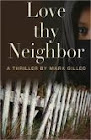
Love Thy Neighbor


Review of Love Thy Neighbor by Mark Gilleo


Overview from www.bn.com: Clark Hayden is a graduate student trying to help his mother navigate through the loss of his father while she continues to live in their house near Washington DC. With his mother’s diminishing mental capacity becoming the norm, Clark expects a certain amount of craziness as he heads home for the holidays. What he couldn’t possibly anticipate, though, is that he would find himself catapulted into the middle of the terrorist operation. As the holiday festivities reach a crescendo, a terrorist cell – which happens to be across the street – is activated. Suddenly Clark is discovering things he never knew about deadly chemicals, secret government operations, suspiciously missing neighbors, and the intentions of a gorgeous IRS auditor. Clark’s quiet suburban neighborhood is about to become one of the most deadly places on the planet, and it’s up to Clark to prevent the loss of hundreds of thousands of innocent lives in the nation’s capital.


My Review:

I really don’t know where to start on this one. It is not a bad story but there were just several things that I didn’t like about it.


First off the title seems a bit misleading. It seems to suggest a Biblical story but the story itself is about a Muslim terrorist cell in residential neighborhood. Clark, our main character (at least I think that is who the author intended him to be), returns home from grad school to take over the care of his mother from a neighbor woman only to find that the neighbor who has been taking care of her while he was gone, might be a terrorist.


The main character is not very strong. This is the reason why I felt unsure as to who really was our main character. Was it Clark? Or the neighbor Ariana? If you reason that Ariana is “the bad guy (or is it girl),” then I suppose that would leave you with Clark. Yet every time someone crosses paths with Clark or Ariana we seem to suddenly shift to his or her POV until he or she comes into contact with one of them or sometimes even with another secondary character. In fact, there are so many new characters introduced throughout the novel that I had a hard time keeping track of them all.


Then there were the f-bombs. Too many of them in my opinion though I know I have read books with more of them but it seemed to be a bit too much.


Finally Clark struck me at times as being unlikable. He seemed to have some disrespect for his love interest and the fact that she forgave him for so many errors was not all that believable. But I guess the hero is always forgiven, even when he’s a jerk, just because he is the hero. I mean we see that Clark has a good side but it really doesn’t come out much in his relationship with the love interest and since she seems like a smart lady who doesn’t need him, why would she put up with that? It doesn’t make sense.


On the plus side, the story has an interesting premise. In the beginning the author explains how a residential address used by two 9-11 conspirators was reported by his own mother as a potential terrorist cell and was never even recorded by the FBI, or was it the CIA? The point seems to be that the author used this as a spring board for the plot of the book wondering what would have happened if someone were to follow up on an alleged terrorist cell living in suburbia.
And there is also plenty of action. The story was engaging, except where I got confused and mostly complex enough not to be trite. However because of the problems I mentioned earlier, I am not recommending this book.


Contains: foul language, violence

Saturday, February 1, 2014

Wondrous Strange


Review of Wondrous Strange by Lesley Livingston

Overview from www.bn.com: Since the dawn of time, the Faerie have taken. . . .
Seventeen-year-old actress Kelley Winslow always thought faeries were just something from childhood stories. Then she meets Sonny Flannery. He's a changeling—a mortal taken as an infant and raised among Faerie—and within short order he's turned Kelley's heart inside out and her life upside down.
For Kelley's beloved Central Park isn't just a park—it's a gateway between her ordinary city and the Faerie's dangerous, bewitching Otherworld. Now Kelley's eyes are opening not just to the Faerie that surround her, but to the heritage that awaits her . . . a destiny both wondrous and strange.

My Review:


And I go off the path I have been on lately to review a story called Wondrous Strange which is part of a series of the same name. It is the first book in the series and is based loosely, I think, on Shakespeare’s play, A Midsummer Night’s Dream.
I won’t go into the details of the Bard’s play, you’ll have to read that one for yourself if you’re interested, but most of the main characters are featured in this story. Because of the writer’s attempt to make it so the reader will not miss the fact that this story is connected with the Shakespeare play; the story is a little slow to start. We begin not with our opening action but instead with what are presumably are main character’s notes on the Shakespeare play which her theater group will perform in very off, off Broadway production.
This is actually the biggest negative for the book since it is the first thing that the reader sees when he or she gets past the Table of Contents and begins to read the story. I for one had no idea why I was being given a summary of Shakespeare’s play along with “Kelly’s notes.” I kept asking myself, what does this have to do with this book? Who the heck is Kelly and why should I care about her notes? I actually thought of quitting right then and there but thought I should at least give the author some time to make her point.
I am sure glad that I did because overall it is a really good story. I then discovered that Kelly is the main character. She is a young girl who is following her dream of being an actress. Cliché, I know but she is not a typical wanna-be actress as we soon discover. In fact, she is not even mortal though she does not know this yet.
She finally gets a break when the lead actress, to whom she is an understudy, gets sick and cannot play the part. But it doesn’t start off well. And in an effort to relearn her lines, she goes to Central Park to practice where she meets Sonny. Sonny is no ordinary mortal either and he is drawn in by her “firecracker” energy. He makes the mistake of talking to her and their relationship just kind of snowballs into love from there.
Unfortunately there are others who want a piece of Kelly and not for all the right reasons. Sonny needs to figure who they are before it is too late while keeping up his job as a Janus guard for the Faerie King Oberon. The ensuing tale is quite a ride and manages to hold out the suspense right up to the end which is why I am recommending it.
Contains: some language though not excessive


Saturday, January 25, 2014

Nefertiti


Review of Nefertiti by Michelle Moran


Overview from www.bn.com: Nefertiti and her younger sister, Mutnodjmet, have been raised in a powerful family that has provided wives to the rulers of Egypt for centuries. Ambitious, charismatic, and beautiful, Nefertiti is destined to marry Amunhotep, an unstable young pharaoh. It is hoped that her strong personality will temper the young ruler’s heretical desire to forsake Egypt’s ancient gods.
From the moment of her arrival in Thebes, Nefertiti is beloved by the people but fails to see that powerful priests are plotting against her husband’s rule. The only person brave enough to warn the queen is her younger sister, yet remaining loyal to Nefertiti will force Mutnodjmet into a dangerous political game; one that could cost her everything she holds dear.


My Review:


This week’s selection came to me by way of last week’s. I had checked out Madame Tussaud from the library’s e-book selection and, as you may have read last week, I liked it a lot. Then when I went to visit the library last week I found a hardcover copy of another one of Michelle Moran’s books. It turns out that it was her first and it is called Nefertiti.


As the title suggests, the book’s subject is Nefertiti, as told through the eyes of her half-sister (not a full sister as the publisher's summary above suggests), Mutnodjmet (or Mutny). Although I love history, I can’t claim to know much about the title character. I knew that she was important in Ancient Egyptian history and might have even been a Pharaoh in her own right after her husband’s death but beyond that I knew nothing.


Moran paints a picture of her as a queen and “chief wife” that is both ruthless and ambitious yet at the same time vulnerable. From an early age she is made aware of the fact that she will be the wife of a Pharaoh. (Another error in the summary as she was originally destined to marry Tuthmosis since he was next in line to the throne.) But when the crown prince Tuthmosis dies her future is in doubt.


Her father, the Vizier Ay, does not like the new prince, Amunhotep IV. After the death of Tuthmosis, Ay sees how the brother behaves and swears he will never allow a daughter of his to be married to the man. There are suggestions that the younger brother killed the elder in a bid for the throne and out of hatred for all of the things that his brother does that he does not agree with. But he quickly relents when he realizes that a rival vizier whose daughter, Kiya, is already married to the new prince would control his family’s destiny since Amunhotep is already under Kiya’s spell.


When they are first married, Nefertiti is not the favored wife. She must use cunning and seduction on her husband if she is ever to get him to see her as someone special, something more than his mother’s choice of a “chief wife.”


The story covers her efforts to first gain Pharaoh’s affection and then go beyond that and become a co-regent herself. She is the key to her family’s dream. She will make sure that they are remembered for all eternity but at what cost? Will she go too far?


Moran presents a Nefertiti that seems often selfish and callous but at the same time we see that there is real affection between her and Mutny, and at times between Nefertiti and her husband. Still Mutny wonders if it the Queen’s feeling for her stem only from her selfishness and insecurities. She often tells Mutny that she doesn’t really understand what she is going through. And she wants to deny her a family of her own in order to have her always available.


In the end, Mutny rejects this and makes something of a life of her own but she always comes back. She can never entirely leave her sister to her own devices. And so she is there still during the birth of the future King Tut. She is there at her sister’s death. She is always there to keep her memory alive.


Contains: some violence, sensuality

Saturday, January 18, 2014

Madame Tussaud


Review of Madame Tussaud by Michelle Moran


Overview from www.bn.com: Smart and ambitious, Marie Tussaud has learned the secrets of wax sculpting by working alongside her uncle in their celebrated wax museum, the Salon de Cire. From her popular model of the American ambassador, Thomas Jefferson, to her tableau of the royal family at dinner, Marie’s museum provides Parisians with the very latest news on fashion, gossip, and even politics. Her customers hail from every walk of life, yet her greatest dream is to attract the attention of Marie Antoinette and Louis XVI; their stamp of approval on her work could catapult her and her museum to the fame and riches she desires. After months of anticipation, Marie learns that the royal family is willing to come and see their likenesses. When they finally arrive, the king’s sister is so impressed that she requests Marie’s presence at Versailles as a royal tutor in wax sculpting. It is a request Marie knows she cannot refuse—even if it means time away from her beloved Salon and her increasingly dear friend, Henri Charles.


My Review:


Madame Tussaud achieved fame through her famous wax museum in London that featured figures that were so life-like people were forced to do a double take. What is not known by most people is who was she really? What was she like? And how did she survive the senseless, graphic violence of French Revolution? This book tells her story through her fictional eyes, though obviously it is not entirely accurate. Fortunately, the author provides information at the back of the story telling us what was changed and why.
At the start of this book, we are introduced to Madame Tussaud though, at this point, she is neither a Madame nor a Tussaud. She is merely a young girl who has had the good fortune to be taught her profession by her uncle and allowed to pursue it unhindered by a society in which women are still expected to marry.


We are introduced to her as Marie Grosholtz, talented apprentice to Philippe Curtius. Whereas Curtius has started this business of model people out of wax, Marie has turned it into a profitable business and appears to have the talent to outshine her uncle. And their fortunes seem to be destined to improve even further when Marie convinces Queen Marie Antoinette’s dressmaker to bring her to visit the salon. Suddenly the lines are down the street and around the corner.


Marie is optimistic about her future. In conversation with an acquaintance she defends her choice to remain single.


“’What about you?’ she asks. ‘Isn’t there anyone you care for?’
‘I have an exhibition to care for,’ I reply. ‘And there are options open to an unmarried woman with ambition. Look at Rose Bertin. From an ordinary seamstress to the milliner of the queen. She is the wealthiest self-made woman in France!’”


Everyone wants to see what the queen saw and eat what she ate. But there is the foreshadowing of dark times ahead.
Already the queen and her husband are becoming unpopular but Marie puts these thoughts aside. As long as she gives the people what they want, she reasons that no harm will come to her. The question is, can she give them what they want when all they want is death?
We sense from Marie’s independence and stubbornness that she will not leave France until she has gotten want she wants out of life. Even if in doing so she risks that same life in the process. She will fall in love and lose that love. She will handle many dead bodies to appease the blood lust of the revolutionary mobs. She will play both sides of the fence before facing her own possible execution, long before she becomes Madame Tussaud and leaves Marie Grosholtz behind. She will start a new life in London, eventually, but at what price?


Her heart-wrenching journey tells us all we need to know. We see all the leaders of the Revolution through her eyes. And it brakes the heart.


Contains: violence, small scenes of sexuality